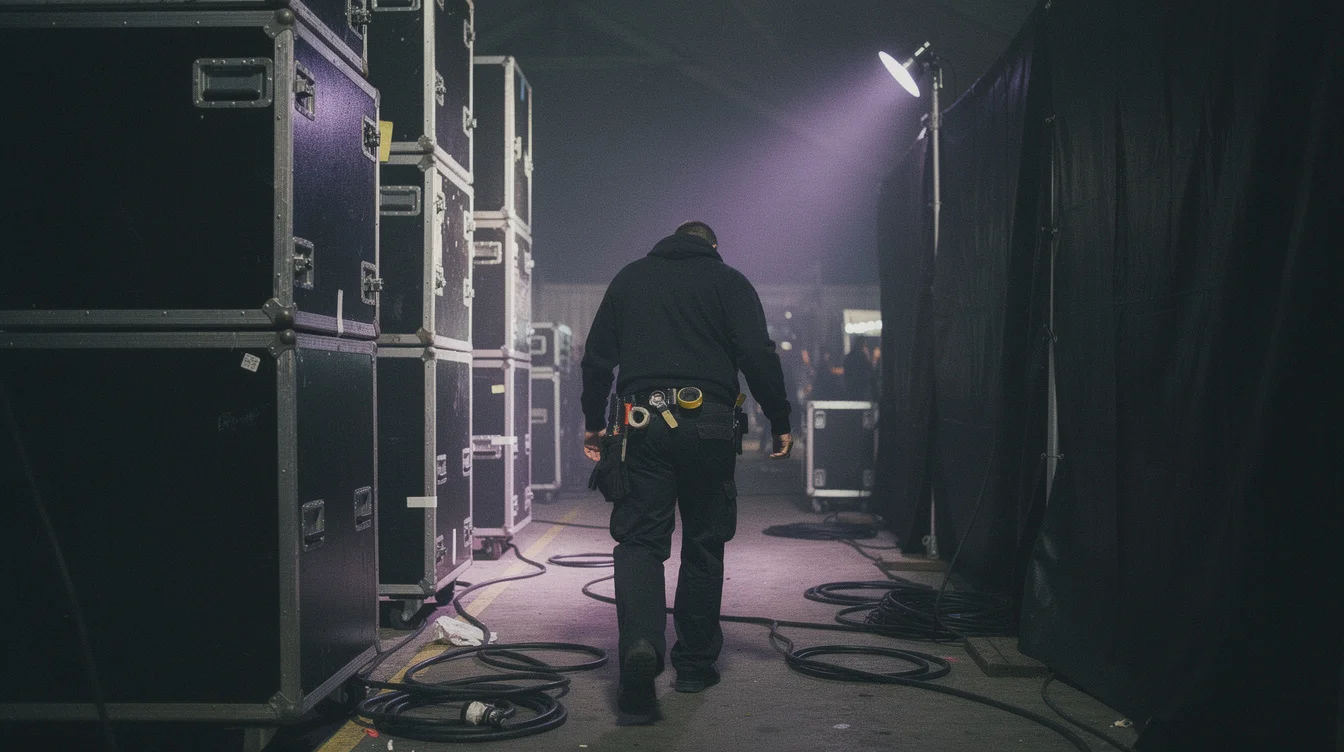
It is 2am on the third day of a major festival. The headline act finished two hours ago, but the backstage compound is still buzzing. Stage crew are breaking down rigs in the dark, working on muscle memory and caffeine. A production manager is dealing with a logistics problem that should have been resolved twelve hours ago. Somewhere in the artist village, a performer who delivered a flawless set to 40,000 people is sitting alone in a trailer, unable to sleep, unable to switch off, unable to explain to anyone what is happening inside their head.
Nobody will check on them. Not because nobody cares, but because the culture backstage does not work that way. You do your job. You handle your own problems. You do not create additional complications for people who are already operating at the edge of their capacity. If you are struggling, you keep it to yourself or you find your own way to cope. And "finding your own way to cope" in a backstage environment often means substances, isolation, or a combination of both.
This is the reality that audiences never see. Behind every seamless festival experience, every perfectly timed set change, every apparently effortless live production, there is a workforce operating under extraordinary pressure with almost no structured support for the human cost of that pressure.
Behind every seamless festival experience, there is a workforce operating under extraordinary pressure with almost no structured support for the human cost of that pressure.
The live events industry has made significant progress in recent years in acknowledging that mental health matters. There are more conversations, more policies, more wellbeing statements in tender documents. But there remains a significant gap between the rhetoric and the reality. The gap is not about intention. Most event organisers genuinely care about their people. The gap is about infrastructure. And closing it requires a fundamentally different approach to how we think about backstage support.
The Problem: A Culture of Silence
The live events industry operates under a set of unwritten rules that everyone in it understands. These rules are rarely stated explicitly, but they shape behaviour as powerfully as any written policy. Chief among them: the show must go on. Whatever is happening to you personally, whatever you are feeling, whatever you are dealing with, the production comes first. This is not cruelty. It is a professional standard born from genuine operational necessity. Shows have schedules. Thousands of people are depending on the production running smoothly. There is no margin for delay and very little tolerance for distraction.
The problem is that this standard, which makes perfect sense as an operational principle, has been absorbed into the culture as a personal mandate. "The show must go on" has become "I must go on." And for many people working in live events, "going on" means suppressing everything that does not serve the immediate demands of the production.
This creates a culture of silence around personal difficulty. People do not speak up when they are struggling because the environment implicitly communicates that speaking up is a form of weakness, an operational liability, a burden on colleagues who have their own pressures to manage. The fear is not irrational. In a freelance-heavy industry where reputation is everything and work comes through personal networks, being seen as unreliable or emotionally fragile carries real professional consequences.
Layered on top of this is the substance culture that permeates many live events environments. Alcohol and drugs are not marginal presences backstage. They are, in many contexts, woven into the social fabric of the work. After a long day, drinking is how people decompress. At festivals, substances circulate freely. For touring professionals spending weeks or months away from home, with disrupted sleep patterns and intense social isolation despite being constantly surrounded by people, substances offer a familiar and readily available form of self-medication.
The industry's relationship with substances is complex. Moralising about it misses the point entirely. People in live events are not using substances because they are reckless or irresponsible. They are using them because the conditions of their work create genuine psychological pressure, and the environment offers very few alternative ways to manage that pressure. Judging the behaviour without addressing the conditions is both unhelpful and dishonest.
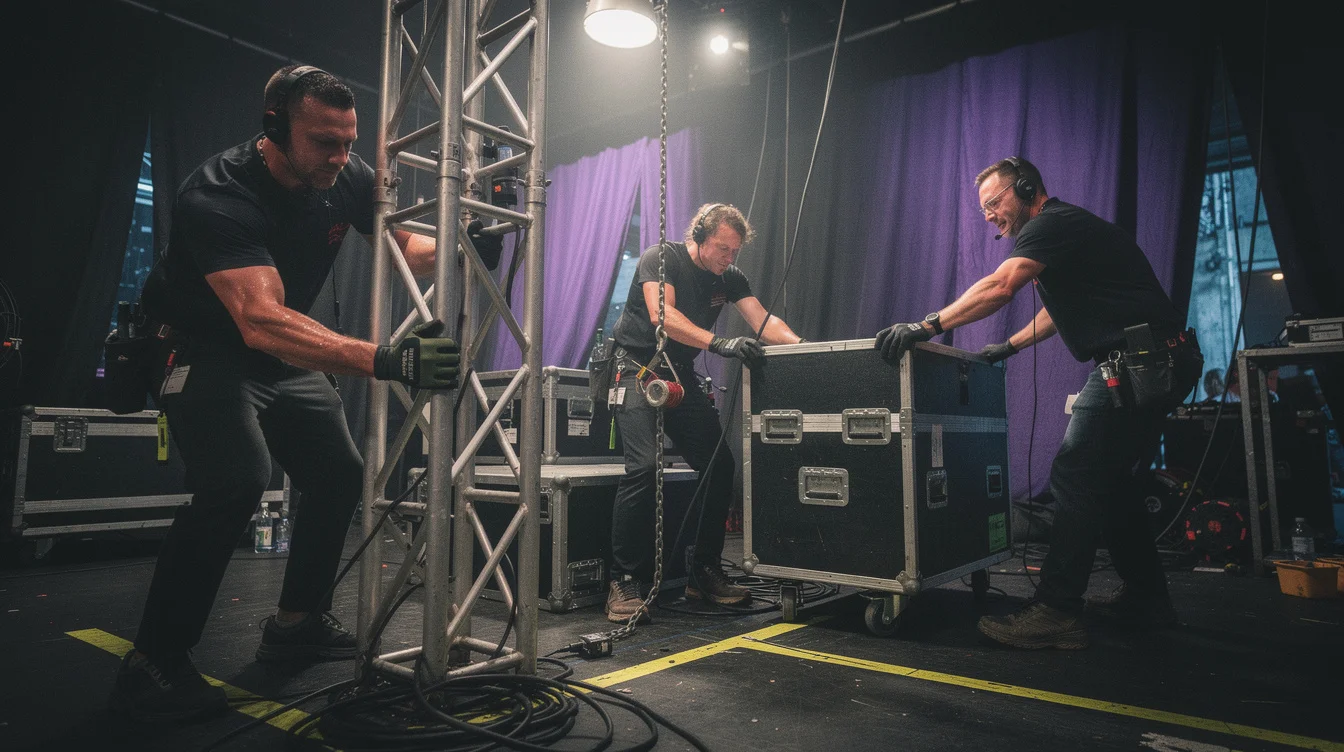
There is also the physical toll. Live events work is physically demanding in ways that are often underestimated from the outside. Long hours, heavy lifting, irregular meals, disrupted circadian rhythms, exposure to extreme noise levels and weather conditions, and the cumulative fatigue of back-to-back events through a festival season. The body is under constant stress, and physical stress amplifies psychological vulnerability.
The welfare provision that does exist at most events is well-intentioned but structurally limited. Welfare tents serve the audience. Mental health first aiders may be present but are typically focused on patron-facing incidents. For the backstage workforce, the people actually delivering the event, there is usually nothing. No dedicated resource. No confidential space. No one whose specific role is to notice when someone is not coping and to offer practical, non-judgemental support.
The Impact: What Happens Without Infrastructure
When there is no support infrastructure backstage, the consequences are both individual and organisational. They are also largely invisible until they become critical.
Individual crisis becomes collective disruption. One person's unmanaged mental health difficulty rarely stays contained. A stage manager who has not slept in three days and is using stimulants to stay functional will eventually make a mistake. A performer experiencing severe anxiety before a set may cancel or underperform. A crew member who is self-medicating with alcohol to manage the accumulated stress of a tour may become volatile, unreliable, or unsafe. In each case, the individual's struggle creates operational consequences that ripple outward through the production.
These are not hypothetical scenarios. They are patterns that repeat across the industry, at events of every scale, involving people at every level of seniority. The festival where a key technician had a breakdown during load-in. The tour where substance use escalated to the point of medical emergency. The production where interpersonal conflict, fuelled by exhaustion and unprocessed stress, nearly derailed a headline performance. These situations are not rare. They are simply not discussed.
The organisational risk is real and growing. Event organisers operate under a duty of care that extends to everyone working on their site. This is not just a moral obligation. It is a legal one. The Health and Safety at Work Act, the Management of Health and Safety at Work Regulations, and the event-specific guidance from the HSE all make clear that employers and organisers have a responsibility to protect the mental as well as the physical health of their workforce.
In practice, most events meet this obligation through policies and procedures rather than through actual provision of support. There is a wellbeing policy in the event safety plan. There is a mental health section in the staff handbook. There are posters and helpline numbers. But the gap between having a policy and having a resource is the gap between good intentions and good outcomes.
Reputational risk compounds the operational risk. In an era of increased scrutiny around workplace welfare, events that fail to provide genuine support for their workforce face growing reputational exposure. A serious incident involving a backstage worker, particularly if it can be shown that no meaningful support was available, carries significant consequences for the organiser's brand, their relationships with artists and agents, and their ability to attract talent and crew for future events.
The absence of support normalises deterioration. Perhaps the most insidious impact of having no backstage support infrastructure is that it normalises the slow deterioration of people's wellbeing. When there is no benchmark for what "supported" looks like, everyone calibrates to what exists: nothing. People accept chronic exhaustion as the price of the work. They accept substance use as the culture of the industry. They accept emotional suppression as professionalism. And because everyone around them is doing the same thing, there is no external signal that something is wrong.
This normalisation is what makes the problem so difficult to see from the inside. The person who is struggling does not feel like they are in an unusual situation. They feel like they are experiencing the same thing as everyone else. And in a sense, they are. That is precisely the problem.
The Solution: Backstage Support as Professional Infrastructure
The live events industry does not need another awareness campaign. It does not need more posters, more helpline numbers, or more wellbeing statements in tender documents. What it needs is infrastructure. Actual, physical, professional support embedded in the backstage environment, available to the people who need it, in the moments when they need it.
This is what backstage resilience support looks like when it is done properly. It is not a welfare tent. It is not a counselling service parachuted into an unfamiliar environment. It is a service built from direct experience of how the live events industry actually works, designed to operate within the culture rather than against it, and delivered by someone who understands the rhythms, the pressures, and the unspoken rules of backstage life.
What harm reduction actually means. The foundation of effective backstage support is a harm reduction approach. This means the focus is on reducing risk and supporting better decisions, not on moralising, policing behaviour, or imposing frameworks that do not reflect the reality of the environment.
Harm reduction acknowledges that substances are present in backstage environments and that the reasons people use them are complex and often valid. It does not ask people to stop. It does not judge. It asks: given the choices you are making, how can we reduce the risk? How can we keep you safer? How can we help you maintain the capacity to do your job and get home in one piece?
This approach works precisely because it does not carry judgement. When people know they will not be lectured, reported, or treated as a problem, they are far more likely to be honest about what they are experiencing. And honesty is the foundation of effective support. Without it, you are guessing.
It is more AAA than A.A. Professional-grade resilience support, like roadside assistance for high-performers under pressure. Discreet, responsive, and designed to get people back on track without shame or unnecessary escalation.
The "more AAA than A.A." philosophy. This is not a recovery programme. It is not a 12-step intervention. It is not therapy. It is a professional-grade support service, analogous to roadside assistance for a high-end vehicle. When something goes wrong, or when the risk of something going wrong is elevated, there is a calm, experienced, professional resource available to help. Discreet, responsive, non-judgemental, and designed to get people back on track without shame, stigma, or unnecessary escalation.
This framing matters because it positions support as a professional service rather than a clinical intervention. Backstage professionals are far more likely to engage with a resource that respects their competence and autonomy than one that pathologises their experience.
How it works operationally. Effective backstage support operates across three phases:
Pre-event: Working with the production team to understand the specific pressures, risks, and dynamics of the event. Identifying high-risk windows (pre-show, post-show, late night, changeover periods). Establishing confidential communication channels. Briefing key personnel on the availability and nature of the support, emphasising confidentiality and non-judgement.
During the event: A discreet, available presence backstage. Not stationed in a tent or behind a desk, but embedded in the environment, visible enough to be accessible, invisible enough not to change the atmosphere. Available for confidential one-to-one conversations, real-time de-escalation during high-stress moments, calm decision support for production managers dealing with people-related situations, and practical harm reduction guidance.
Post-event: Optional debrief support for the production team. Reviewing what worked, what was difficult, and what might be done differently next time. This is not a clinical review. It is a practical operational debrief that helps event leaders build a more realistic picture of the human dynamics of their events.
Confidentiality is the foundation. Nothing works without trust, and trust requires absolute confidentiality. Every engagement operates to NDA-level standards as default. Nothing discussed on-site is shared with management, promoters, agents, or anyone else, unless there is a genuine and immediate risk to life. This is non-negotiable.
That guarantee is what allows people to be honest. A touring musician can talk about their substance use without fearing it will reach their manager. A stage crew member can admit they are on the edge of burnout without worrying it will affect their next booking. A production manager can acknowledge that they are overwhelmed without it being held against them.
Without this level of confidentiality, the service becomes another version of the same problem: a resource that exists on paper but that nobody trusts enough to actually use.
What changes when support is present. The most significant impact of embedded backstage support is not measured in the number of people who use it. It is measured in the shift that occurs when people know it is there. The knowledge that a professional, confidential resource exists changes the backstage environment in subtle but meaningful ways. It gives people permission to be honest with themselves. It provides a safety net that makes it possible to take the risk of asking for help. It communicates, through action rather than policy, that the organisation genuinely values the wellbeing of its people.
Events that have embedded this kind of support report fewer critical incidents, smoother operational flow during high-pressure periods, and improved retention of key crew members across seasons. The return on investment is not primarily financial, though the financial case is straightforward. It is cultural. It changes the baseline of what "supported" means in a backstage environment.
This is not a luxury. It is professional infrastructure for an industry that asks extraordinary things of its people. The question is not whether backstage support is necessary. The evidence on that point is overwhelming. The question is whether event organisers are willing to move from acknowledging the problem to actually investing in the solution.
If you organise events, manage tours, or oversee productions where people are working under sustained pressure, consider what your current support provision actually looks like in practice. Not what it says in the policy document. What is actually available to your crew, your performers, and your production team at 2am on the third day of a festival.
If the answer is "not much," that is not an unusual position. But it is a solvable one. Professional backstage resilience support exists. It is discreet, practical, and designed for the specific conditions of your industry. And it does not require you to change the culture overnight. It simply requires the decision to invest in the people who make your events happen.

James Duke-Evans
Founder, Unlocked Resilience
Over 20 years of experience working in and around live music, festivals, touring, and high-pressure event environments. James provides embedded backstage resilience and harm reduction support built from direct knowledge of the industry.